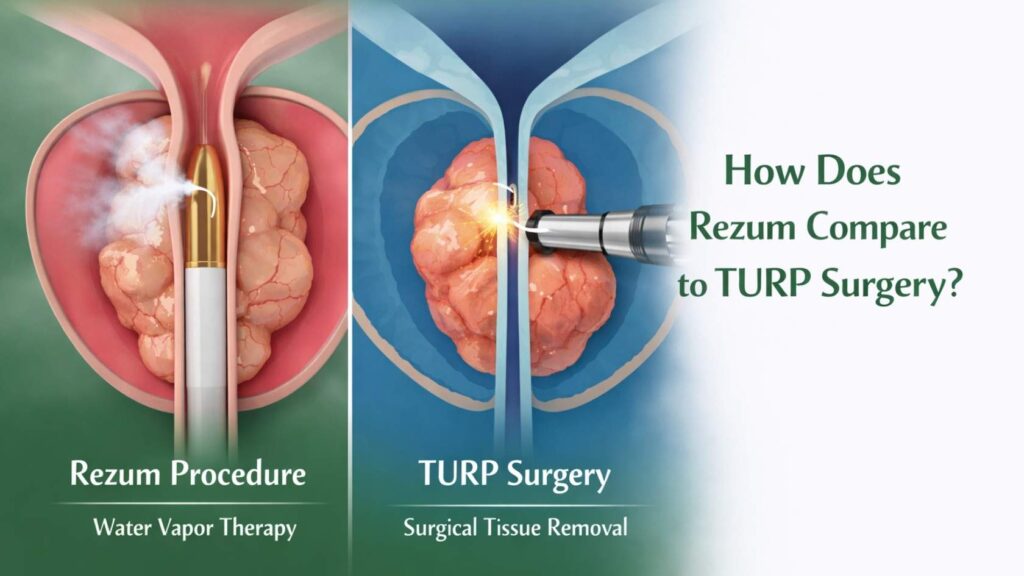
How Does Rezum Compare to TURP Surgery?
Rezum water vapor therapy is a minimally invasive, outpatient alternative to TURP for BPH, offering faster recovery (days vs. weeks) and helping preserve sexual function. While TURP (transurethral resection of the prostate) is considered the traditional gold standard for larger prostates, Rezum provides effective, durable, and lower-risk symptom relief — particularly for men who prioritize sexual health.
Understanding how Rezum compares to TURP surgery helps patients choose the treatment that best matches their symptoms, lifestyle, and expectations.
Understanding the Two Procedures
Both Rezum and TURP are used to treat urinary symptoms caused by prostate enlargement, but they work in very different ways.
Rezum Therapy
Rezum uses controlled water vapor (steam) delivered through a small device to shrink excess prostate tissue. The body gradually absorbs the treated tissue over time, relieving urinary blockage.
TURP Surgery
TURP is a surgical procedure that removes prostate tissue using a specialized instrument inserted through the urethra. It directly cuts away obstructing tissue to improve urine flow.
Key Comparisons Between Rezum and TURP
1. Procedure Approach
Rezum
Minimally invasive
No surgical incisions
Uses steam energy
Typically performed in an outpatient setting
TURP
Invasive surgical procedure
Requires tissue removal
Performed in an operating room
2. Recovery Time
Rezum
Faster recovery
Return to normal activities in days
Minimal downtime
TURP
Longer recovery period
Activity restrictions may last weeks
Requires closer monitoring
This makes Rezum appealing for those seeking quicker return to daily life.
3. Impact on Sexual Function
Rezum
Generally preserves ejaculation
Lower risk of sexual side effects
TURP
Retrograde ejaculation is very common
Sexual function changes may occur
For men who prioritize preserving sexual function, Rezum is often preferred.
4. Effectiveness and Suitability
TURP
Highly effective for:
Severe symptoms
Larger prostates
Provides immediate tissue removal
Rezum
Ideal for:
Mild-to-moderate symptoms
Medium-sized prostates
Works gradually as tissue shrinks
TURP may be more suitable for advanced cases, while Rezum offers a balanced approach for moderate
5. Risks and Complications
Rezum
Lower risk of serious complications
Temporary urinary symptoms during recovery
Temporary catheter may be needed (around 4 days)
TURP
Risk of bleeding
Longer hospital stay
Rare complications such as fluid imbalance
Rezum avoids many surgical risks associated with traditional procedures.
6. Side Effects
Rezum
Temporary urgency
Mild discomfort
Short-term urinary irritation
TURP
Possible bleeding
Fluid-related complications
Longer catheter duration
Long-Term Outcomes
TURP provides strong long-term relief for severe prostate enlargement. However, Rezum also delivers durable symptom improvement for appropriately selected patients.
The choice often depends on:
Prostate size
Symptom severity
Health condition
Personal priorities
Which Option Is Right?
Rezum is often chosen by men who want:
Minimally invasive treatment
Faster recovery
Lower complication risk
Preservation of sexual function
TURP may be more suitable for:
Larger prostates
Severe urinary obstruction
Cases requiring immediate tissue removal
Making an Informed Decision
Both treatments are effective. The best choice depends on individual needs and expectations.
Some patients prioritize:
Faster recovery
Outpatient treatment
Reduced sexual side effects
Others may require:
More aggressive surgical intervention
Final Thoughts
Rezum represents a modern treatment option for men seeking symptom relief without the risks associated with traditional surgery. TURP remains a powerful solution for advanced cases.
Understanding how Rezum compares to TURP surgery allows patients to weigh convenience, recovery time, effectiveness, and lifestyle considerations before choosing the most suitable approach.
Frequently Asked Questions
1. What is the main difference between Rezum and TURP?
Rezum uses steam to shrink prostate tissue, while TURP surgically removes excess tissue.
2. Is Rezum less invasive than TURP surgery?
Yes, Rezum is a minimally invasive procedure, whereas TURP is a traditional surgical treatment.
3. Which treatment has a faster recovery time?
Rezum generally allows a quicker return to normal activities compared to TURP.
4. Does Rezum preserve sexual function better than TURP?
Rezum typically has a lower risk of affecting ejaculation compared to TURP.
5. Which procedure is better for larger prostates?
TURP is often preferred for larger prostates or more severe symptoms.
6. Is hospitalization required for Rezum therapy?
Rezum is usually performed as an outpatient procedure.
7. Can Rezum provide long-term symptom relief?
Yes, Rezum can offer durable relief for appropriately selected patients.
8. Are complications more common with TURP?
TURP carries a higher risk of surgical complications compared to minimally invasive options.
9. Will I need a catheter after Rezum or TURP?
Temporary catheter use may be required after both procedures.
10. How do I decide between Rezum and TURP?
The choice depends on prostate size, symptom severity, and personal treatment priorities.