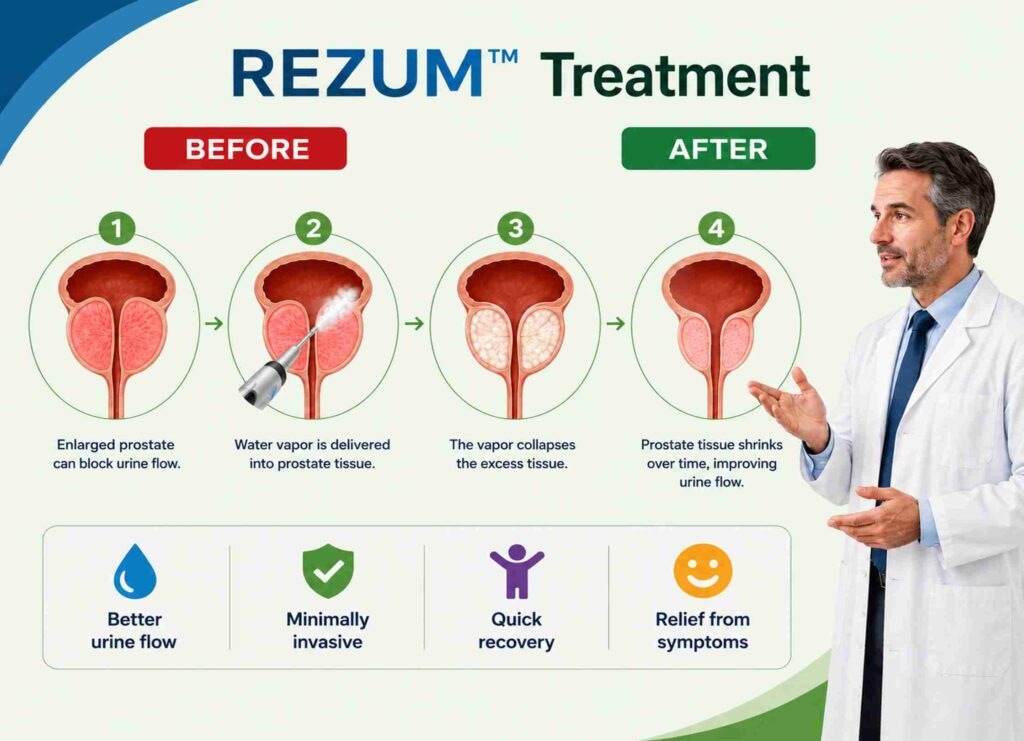
Learning about rezum treatment before and after can help patients understand how enlarged prostate symptoms may improve following minimally invasive therapy. Men with benign prostatic enlargement often experience urinary difficulties that slowly interfere with sleep, comfort, travel, and regular daily activities. Symptoms may continue progressing over time, leading many individuals to explore alternative treatment options beyond medication.
People searching for rezum treatment before and after commonly want to understand how urinary function may change after recovery, what improvements are usually noticed, and how the healing process progresses. Rezum therapy uses thermal energy created from sterile steam to reduce excess prostate tissue without traditional surgery. As the treated tissue gradually decreases, pressure on the urinary passage may lessen and urine flow may improve.
This article explains rezum treatment before and after, including symptom progression, expected recovery, physical improvements, healing stages, treatment advantages, and possible long-term results.
Table of Contents
- Understanding Rezum Treatment Before And After For Enlarged Prostate
- Introduction To Rezum Therapy
- Problems Experienced Before Treatment
- Reasons Patients Consider Rezum Therapy
- What Occurs During The Procedure
- Early Recovery Phase After Treatment
- Urinary Function Changes After Therapy
- Sleep Pattern Improvements
- Everyday Lifestyle Benefits
- Temporary Recovery Symptoms
- Gradual Healing And Tissue Reduction
- Long-Term Benefits After Treatment
- Importance Of Post-Treatment Monitoring
- Treatment Safety And Evaluation
- Summary
1. Understanding Rezum Treatment Before And After For Enlarged Prostate
The prostate gland may naturally increase in size as men grow older. When enlargement occurs, the gland can press against the urethra and affect normal urination. This condition is commonly called benign prostatic hyperplasia.
As the prostate continues enlarging, urinary symptoms may become more noticeable and uncomfortable.
2. Introduction To Rezum Therapy
Rezum therapy is a minimally invasive procedure designed to manage urinary symptoms caused by prostate enlargement.
The treatment delivers controlled water vapor into enlarged prostate tissue. Heat generated from the steam damages excess cells, which are later absorbed naturally by the body. As swelling decreases, urinary passage obstruction may gradually reduce. Many patients are interested in this option because it avoids major surgical incisions.
3. Problems Experienced Before Treatment
Before undergoing therapy, patients may experience persistent urinary difficulties that affect everyday life.
Common symptoms include:
Frequent Bathroom Visits
Needing to urinate repeatedly throughout the day.
Interrupted Night Sleep
Waking several times at night due to urinary urgency.
Reduced Urine Pressure
Weak urinary stream during bladder emptying.
Delayed Urination
Difficulty initiating urine flow.
Persistent Bladder Fullness
Feeling incomplete bladder emptying after urination.
These concerns often encourage patients to explore treatment expectations
4. Reasons Patients Consider Rezum Therapy
Individuals may consider Rezum therapy when urinary symptoms begin affecting overall wellbeing.
Common reasons include:
- Increasing urinary discomfort
- Sleep disruption caused by frequent urination
- Reduced effectiveness of medications
- Interest in non-surgical treatment options
- Difficulty managing everyday routines
Many patients seek information to understand possible symptom relief.
5. What Occurs During The Procedure
Rezum therapy is generally performed during a short outpatient visit.
During the procedure:
- A specialized instrument is inserted through the urinary passage
- Sterile steam is delivered into enlarged prostate areas
- Thermal energy targets excess tissue
- Treated tissue gradually shrinks over time
Because the treatment does not involve large incisions, recovery is often more manageable than traditional surgery.
6. Early Recovery Phase After Treatment
Healing after Rezum therapy varies depending on individual recovery response.
During the initial recovery period, some patients may notice:
- Mild discomfort while urinating
- Temporary increase in urinary frequency
- Urgency sensations
- Mild pelvic irritation
- Temporary catheter support in selected cases
These effects are usually temporary and improve during healing
7. Urinary Function Changes After Therapy
Urinary improvement is one of the main treatment goals.
Before Treatment
Many individuals experience:
- Slow urine flow
- Frequent urgency
- Difficulty emptying the bladder
- Repeated night urination
- Reduced daily comfort
After Treatment
Following recovery, patients may gradually notice:
- Improved urine stream strength
- Easier bladder emptying
- Better urinary control
- Reduced bathroom frequency
- Improved comfort during daily activities
Improvements may continue gradually over several weeks.
8. Sleep Pattern Improvements
Night-time urination can significantly affect sleep quality before treatment.
Before Therapy
Repeated waking during the night may cause:
- Poor sleep quality
- Daytime tiredness
- Reduced concentration
- Lower daily energy levels
After Therapy
As urinary frequency decreases, patients may experience:
- Longer uninterrupted sleep
- Better daily alertness
- Improved restfulness
- Reduced nighttime discomfort
These changes may positively affect overall wellbeing.
9. Everyday Lifestyle Benefits
Urinary symptoms may interfere with many regular activities before therapy.
Before Treatment
Patients may avoid:
- Long-distance travel
- Extended meetings
- Outdoor activities
- Social gatherings
After Treatment
Improved urinary control may support:
- Better travel convenience
- Increased daily confidence
- Improved work comfort
- Easier participation in social activities
Gradual symptom relief may positively affect overall lifestyle
10. Temporary Recovery Symptoms
Like many medical procedures, Rezum therapy may involve short-term side effects during recovery.
Possible temporary symptoms include:
- Mild burning sensation
- Small amounts of blood in urine
- Temporary urgency
- Mild pelvic discomfort
- Short-term urination difficulty
Most recovery symptoms improve gradually with proper follow-up care.
11. Gradual Healing And Tissue Reduction
Rezum therapy does not produce immediate full results because treated prostate tissue shrinks gradually.
During recovery:
- The body absorbs damaged tissue naturally
- Swelling slowly decreases
- Urinary passage pressure reduces
- Bladder emptying may improve progressively
Patients should understand that recovery changes usually occur step by step.
12. Long-Term Benefits After Treatment
Many patients experience continued urinary improvement after complete recovery.
Potential long-term benefits may include:
- Better urine flow
- Reduced urgency
- Improved bladder function
- Less night-time urination
- Greater daily comfort
Long-term symptom improvement may support better quality of life.
13. Importance Of Post-Treatment Monitoring
Medical follow-up remains important after Rezum therapy.
Doctors may evaluate:
- Symptom improvement
- Healing progress
- Urinary flow changes
- Bladder function
- Recovery-related concerns
Regular monitoring helps assess treatment effectiveness over time.
14. Treatment Safety And Evaluation
Although Rezum therapy is considered minimally invasive, proper medical assessment is still necessary.
Doctors may review:
- Prostate size
- Urinary health
- Existing medical conditions
- Previous urinary procedures
- Overall physical condition
Individual suitability varies from patient to patient.
15. Summary
Understanding rezum treatment before and after helps patients learn how minimally invasive therapy may improve urinary symptoms caused by enlarged prostate. Before treatment, many individuals experience frequent urination, weak urine flow, disturbed sleep, urgency, and difficulty emptying the bladder, which may gradually affect daily comfort and overall quality of life.
After Rezum therapy, the enlarged prostate tissue gradually shrinks over time, which may help improve urinary flow, bladder emptying, sleep quality, and overall urinary control. Since the procedure does not involve major surgery, many patients prefer it as a minimally invasive option with manageable recovery.
With proper medical evaluation, follow-up care, and recovery guidance, Rezum therapy may support long-term urinary improvement and better daily comfort for selected patients. For more information related to REZUM Treatment Before and After, visit: “World Health Organization“
frequently asked questions
What is rezum treatment before and after?
Rezum treatment before and after refers to the changes patients may notice in urinary symptoms before undergoing Rezum therapy and during recovery after the procedure
How does Rezum therapy work for enlarged prostate?
Rezum therapy uses controlled water vapor energy to target and reduce excess prostate tissue that blocks normal urine flow.
How long does it take to see rezum treatment before and after results?
Many patients notice gradual urinary improvement over several weeks as the treated prostate tissue shrinks naturally.
Can Rezum therapy improve weak urine flow?
Yes, many patients experience improved urine flow after recovery from Rezum treatment.
Is Rezum therapy considered minimally invasive?
Yes, Rezum therapy is considered a minimally invasive procedure because it does not involve major surgical incisions.
What symptoms may improve after Rezum treatment?
Symptoms such as frequent urination, urgency, weak urine stream, night-time urination, and incomplete bladder emptying may improve over time.
Are temporary side effects common after Rezum therapy?
Some patients may temporarily experience mild burning during urination, urinary urgency, or slight discomfort during recovery.
Does Rezum treatment require hospitalization?
Rezum therapy is commonly performed as a short outpatient procedure, and many patients return home the same day.
Can Rezum treatment improve sleep quality?
Reduced night-time urination after recovery may help improve sleep quality for many patients.
Is follow-up care important after Rezum therapy?
Yes, regular follow-up appointments help doctors monitor healing, urinary improvement, and overall treatment progress.