9 Powerful Reasons to Choose Rezum Therapy Hospital in Dubai
Finding the right Rezum Therapy Hospital in Dubai can be an important step for men experiencing urinary difficulties caused by benign prostatic hyperplasia. This condition, commonly called BPH or an enlarged prostate, may lead to frequent urination, a weak urine stream, disturbed sleep, and difficulty emptying the bladder.
Rezum therapy is a minimally invasive treatment that uses controlled water-vapour energy to target excess prostate tissue. It is often considered by patients who want meaningful symptom improvement without undergoing major prostate surgery.
A properly equipped Rezum Therapy Hospital in Dubai should provide complete evaluation, careful patient selection, clear treatment guidance, safe procedural care, and structured follow-up. This guide explains the causes and symptoms of BPH, how Rezum works, its benefits, treatment stages, recovery tips, possible risks, and questions patients should ask before proceeding.
What Is Rezum Therapy?
Rezum therapy is a minimally invasive procedure developed to treat lower urinary tract symptoms caused by benign prostatic hyperplasia.
During the procedure, a small instrument is passed through the urethra. Controlled amounts of sterile water vapour are then delivered into selected areas of enlarged prostate tissue.
The steam releases thermal energy into the targeted tissue. This causes the excess cells to break down gradually. Over the following weeks, the body naturally absorbs the treated tissue, reducing pressure on the urethra.
As the urinary passage becomes more open, patients may notice:
- A stronger urine stream
- Easier bladder emptying
- Reduced urinary urgency
- Fewer night-time toilet visits
- Less straining during urination
- Improved comfort and confidence
A Rezum Therapy Hospital in Dubai may recommend the treatment when symptoms are affecting daily life and medication has not provided sufficient relief.
Understanding Benign Prostatic Hyperplasia
Benign prostatic hyperplasia is a non-cancerous enlargement of the prostate gland. The prostate is located below the bladder and surrounds part of the urethra, the tube that carries urine out of the body.
When the gland enlarges, it may compress or narrow the urethra. The bladder then has to work harder to push urine through the restricted passage.
Over time, this may cause urinary symptoms and interfere with sleep, travel, work, exercise, and social activities.
BPH is not prostate cancer. However, some symptoms of BPH can overlap with symptoms caused by other urinary or prostate conditions. Medical evaluation is therefore necessary before choosing treatment.
A consultation at a Rezum Therapy Hospital in Dubai may include an assessment of symptom severity, prostate size, bladder function, general health, and previous treatment history.
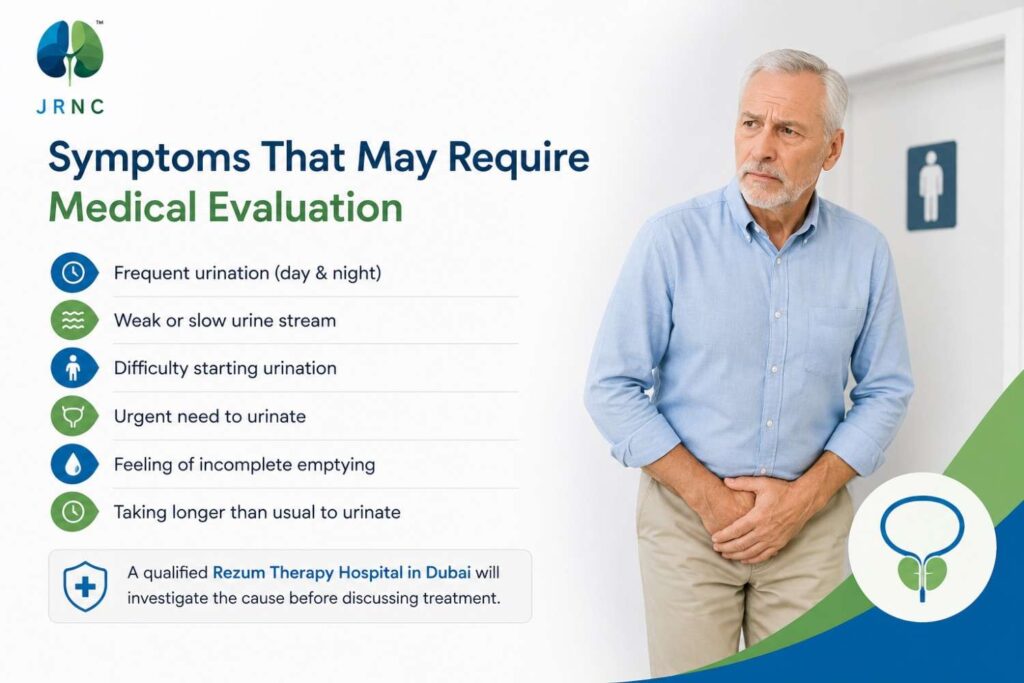
Symptoms That May Require Medical Evaluation
BPH symptoms vary considerably. Some men have a visibly enlarged prostate but only mild symptoms. Others may experience significant urinary difficulty even with moderate enlargement.
Common symptoms include:
- Frequent urination during the day
- Waking repeatedly at night to urinate
- Weak or slow urine stream
- Difficulty beginning urination
- Stopping and starting while passing urine
- Straining to empty the bladder
- Sudden urinary urgency
- Urine leakage before reaching the toilet
- Dribbling after urination
- Feeling that the bladder remains partly full
- Taking longer than usual to urinate
- Reduced confidence during travel or social activities
Symptoms should not be diagnosed based only on age. Similar difficulties can occur with urinary tract infection, bladder stones, urethral narrowing, neurological conditions, medication effects, or other prostate disorders.
A qualified Rezum Therapy Hospital in Dubai will usually investigate the cause before discussing treatment.
Types of BPH Symptoms
BPH symptoms are commonly grouped into storage symptoms and voiding symptoms.
Storage Symptoms
Storage symptoms occur while the bladder is holding urine.
They may include:
- Frequent urination
- Urgent need to urinate
- Night-time urination
- Urge-related leakage
Voiding Symptoms
Voiding symptoms occur while urine is leaving the bladder.
They may include:
- Weak urine flow
- Hesitancy
- Straining
- Interrupted urine stream
- Prolonged urination
- Incomplete emptying
Post-Urination Symptoms
These symptoms occur immediately after urination.
They may include:
- Dribbling
- Feeling that urine remains in the bladder
- Needing to return to the toilet shortly afterwards
Identifying the dominant symptom type helps a Rezum Therapy Hospital in Dubai determine whether the prostate is the main cause or whether additional bladder assessment is required.
When to Seek Urgent Medical Care
Most BPH symptoms develop gradually. However, certain signs require prompt medical evaluation.
Seek urgent care for:
- Complete inability to pass urine
- Severe lower abdominal pain
- Fever with urinary symptoms
- Visible or persistent blood in the urine
- Repeated urinary infections
- Severe back or side pain
- Sudden worsening of urinary function
- Confusion or weakness associated with infection
- Reduced urine output with swelling
These problems may require immediate catheterisation, infection treatment, imaging, or other urgent care rather than a planned Rezum procedure.
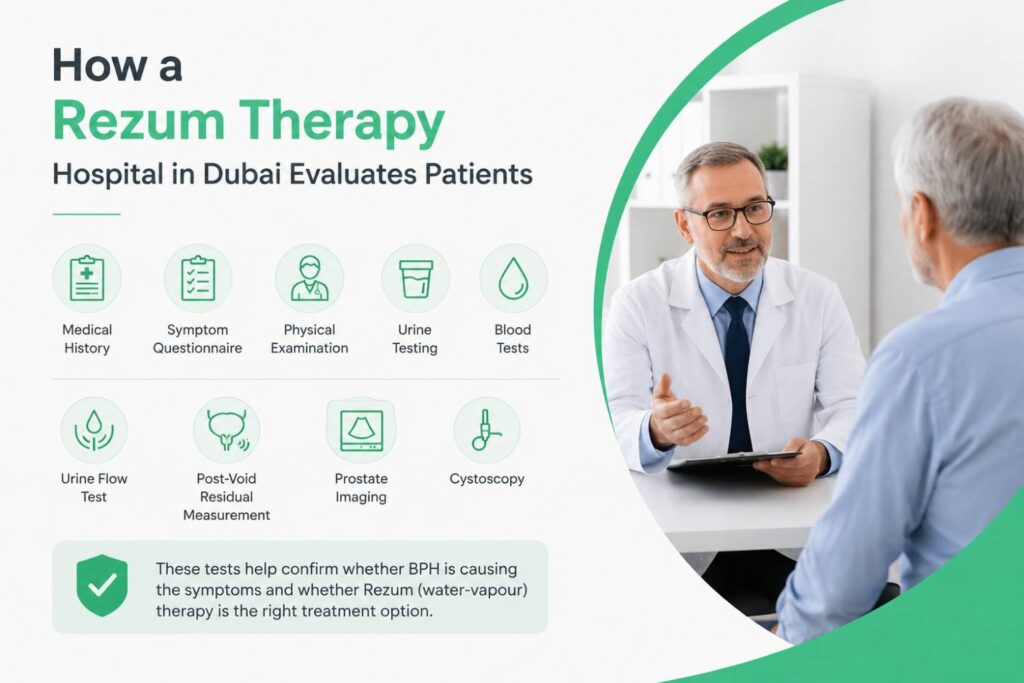
How a Rezum Therapy Hospital in Dubai Evaluates Patients
A complete assessment is essential because Rezum therapy is suitable for selected patients rather than every person with urinary symptoms.
Medical History
The specialist may ask about:
- The type and duration of symptoms
- Night-time urination
- Urinary urgency
- Previous infections
- Current medicines
- Earlier prostate treatments
- Bladder or kidney conditions
- Neurological disorders
- Overall medical health
Symptom Questionnaire
A structured urinary symptom score may be used to measure how strongly BPH affects daily life.
Physical Examination
The examination may include abdominal assessment and, when clinically appropriate, prostate evaluation.
Urine Testing
A urine test can help identify infection, blood, glucose, or other abnormalities.
Blood Tests
Blood tests may be recommended to evaluate kidney function or prostate-related markers when appropriate.
Urine Flow Test
A flow test measures the speed and pattern of urination.
Post-Void Residual Measurement
An ultrasound may be used to calculate how much urine remains in the bladder after urination.
Prostate Imaging
Ultrasound or other imaging can help estimate prostate size and anatomy.
Cystoscopy
In selected cases, a thin camera may be used to examine the urethra, prostate channel, and bladder.
The purpose of these tests is to help the Rezum Therapy Hospital in Dubai confirm whether BPH is causing the symptoms and whether water-vapour therapy is technically appropriate.
Who May Be Suitable for Rezum Therapy?
Rezum may be considered for men who:
- Have bothersome urinary symptoms caused by BPH
- Have not obtained adequate relief from medication
- Experience unwanted medication side effects
- Prefer a minimally invasive option
- Want to avoid major surgery when medically suitable
- Have prostate anatomy compatible with the treatment
- Understand that improvement develops gradually
- Can attend follow-up appointments
- Are medically fit for the planned anaesthesia or sedation
- Have realistic expectations about results
A Rezum Therapy Hospital in Dubai should explain that suitability depends on more than prostate size alone. Bladder function, median-lobe anatomy, infection status, urinary retention, and previous procedures may all influence the decision.
Who May Need a Different Treatment?
Rezum may not be the most suitable choice for every patient.
Alternative treatment may be necessary when a person has:
- An active urinary tract infection
- Untreated bladder stones
- Significant urethral narrowing
- Severe bladder weakness
- Very complex prostate anatomy
- Certain neurological bladder disorders
- A need for rapid removal of major obstruction
- Suspicion of another prostate condition
- Previous procedures that affect access
- A medical condition that changes procedural safety
In such cases, a Rezum Therapy Hospital in Dubai may discuss medication, laser treatment, TURP, catheter management, bladder treatment, or another suitable approach.
What Happens Before Rezum Treatment?
Preparation varies according to the patient’s health and hospital protocol.
Patients may receive instructions about:
- Eating and drinking before the procedure
- Blood-thinning medication
- Diabetes medicines
- Urine testing
- Antibiotics when indicated
- Transportation after treatment
- Temporary catheter use
- Activity restrictions
- Follow-up dates
Patients should provide a complete list of prescription medicines, over-the-counter products, and supplements.
They should not independently stop blood thinners or other important medication. Any changes should be directed by the treating doctor.
A reliable Rezum Therapy Hospital in Dubai should provide written preparation instructions and explain what to expect on the treatment day.
Conclusion
Choosing a Rezum Therapy Hospital in Dubai involves understanding the cause of urinary symptoms, confirming that BPH is responsible, and determining whether water-vapour treatment suits the patient’s prostate anatomy and overall health.
Rezum therapy may offer meaningful symptom relief, a minimally invasive approach, shorter recovery, reduced dependence on medication, and preservation of important functions for appropriately selected patients. However, results develop gradually, temporary urinary symptoms are common, and some men may need a catheter or further treatment.
A detailed consultation with a qualified urologist can help patients compare Rezum with medication, laser procedures, TURP, prostate lift treatments, and other options. Selecting a well-equipped Rezum Therapy Hospital in Dubai with clear communication and reliable follow-up can support safer treatment decisions and a more confident recovery. For reliable medical information about benign prostatic hyperplasia (BPH), visit the U.S. National Library of Medicine (MedlinePlus) to learn more about its symptoms, causes, diagnosis, and treatment options.