HOW DOES REZUM THERAPY WORK?
Understanding HOW DOES REZUM THERAPY WORK? can help men with benign prostatic hyperplasia (BPH) make informed decisions about their treatment options. Rezum therapy is a minimally invasive procedure that uses controlled water-vapor energy to treat selected areas of enlarged prostate tissue. The treated tissue gradually reduces as the body processes it, helping create more space for urine to pass through the urethra.A REZUM TREATMENT CLINIC IN SHARJAH can provide a professional evaluation to determine whether this minimally invasive approach is suitable based on the patient’s prostate condition and urinary symptoms.This treatment is designed to address the prostate tissue contributing to urinary obstruction without requiring conventional surgical removal of the tissue. However, whether Rezum is appropriate depends on individual prostate anatomy, symptoms, medical history, and urological assessment.
What Is Rezum Therapy?
Rezum therapy is a minimally invasive treatment used to manage urinary symptoms associated with benign prostatic hyperplasia, or BPH.BPH occurs when the prostate gland becomes enlarged. Because the prostate surrounds part of the urethra, enlargement can narrow the urinary passage and make it harder for urine to flow freely.
Common symptoms include:
- Weak urinary stream
- Difficulty starting urination
- Frequent urination
- Urinary urgency
- Increased night-time urination
- Interrupted urine flow
- Feeling that the bladder has not completely emptied
- Dribbling after urination
Instead of cutting away prostate tissue, Rezum delivers controlled water vapor into selected areas of the prostate.The thermal energy affects the targeted tissue. During the following weeks and months, the body gradually processes the treated tissue. This can reduce the amount of tissue contributing to obstruction.
HOW DOES REZUM THERAPY WORK?
The answer to HOW DOES REZUM THERAPY WORK? begins with understanding the role of water vapor.During the procedure, a specialized device delivers small amounts of sterile water vapor into targeted areas of the enlarged prostate.The water vapor carries thermal energy. When it reaches the selected prostate tissue, the heat causes controlled cellular damage.The treated tissue does not simply disappear immediately. Instead, the body gradually breaks down and absorbs the affected tissue during the healing process.As this happens, the obstructing prostate tissue can decrease, creating additional space around the urethra.
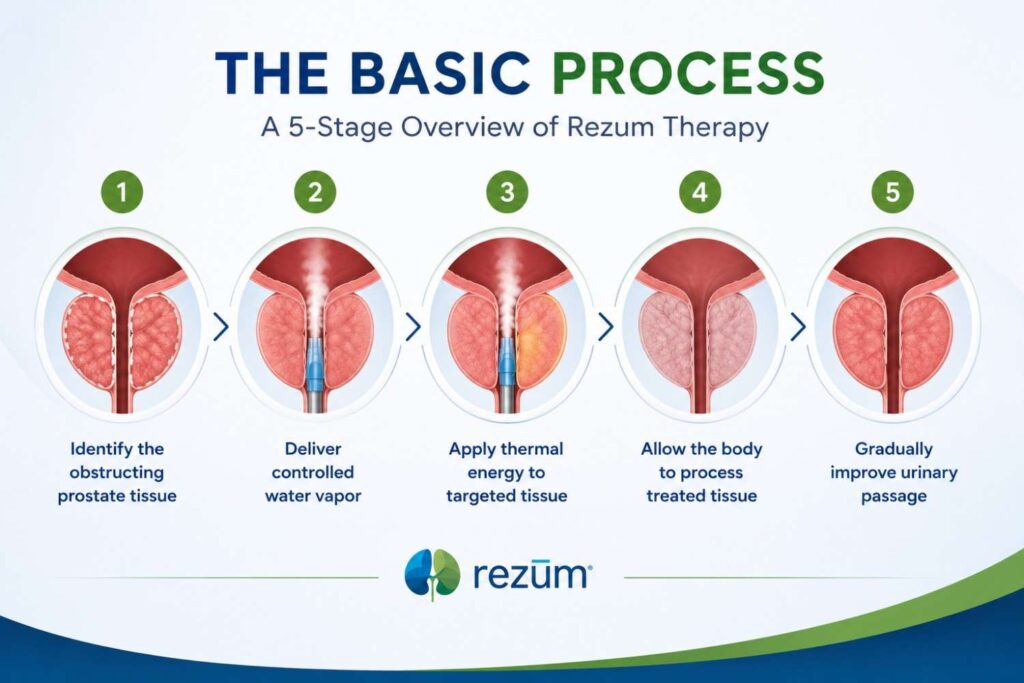
The Basic Process
The treatment can be understood in five stages:
- Identify the obstructing prostate tissue
- Deliver controlled water vapor
- Apply thermal energy to targeted tissue
- Allow the body to process treated tissue
- Gradually improve urinary passage
This gradual mechanism is one of the key features of Rezum therapy.
How Water Vapor Treats Prostate Tissue
Water vapor is used because it can efficiently transfer thermal energy to targeted tissue.The urologist introduces the treatment device through the urinary passage and positions it in the selected area of the prostate.A controlled amount of water vapor is released into the tissue.The thermal energy affects the prostate cells in that specific treatment area. The process is repeated in different locations depending on the prostate’s size and shape.
Why Targeted Treatment Matters
The objective is not to treat every part of the prostate.Instead, the urologist identifies areas contributing to urinary obstruction and delivers treatment where appropriate.This targeted approach allows the procedure to focus on tissue that is contributing to symptoms.
How Does Rezum Reduce Urinary Obstruction?
One of the most important parts of understanding HOW DOES REZUM THERAPY WORK? is understanding what happens after the procedure.The prostate does not immediately shrink at the end of treatment.Instead, the process occurs progressively.The water vapor causes controlled thermal injury to selected prostate cells. During healing, the body gradually breaks down and removes the treated tissue.As the treated tissue reduces, the prostate may place less pressure on the urethra.This can improve the space available for urine flow.
From Treatment to Symptom Improvement
The process generally follows this pattern:
Water vapor → thermal treatment → tissue response → healing → tissue reduction → improved urinary passageBecause this is a gradual biological process, urinary improvement may take time.Patients should not expect the final result immediately after treatment.
Who May Be Suitable for Rezum?
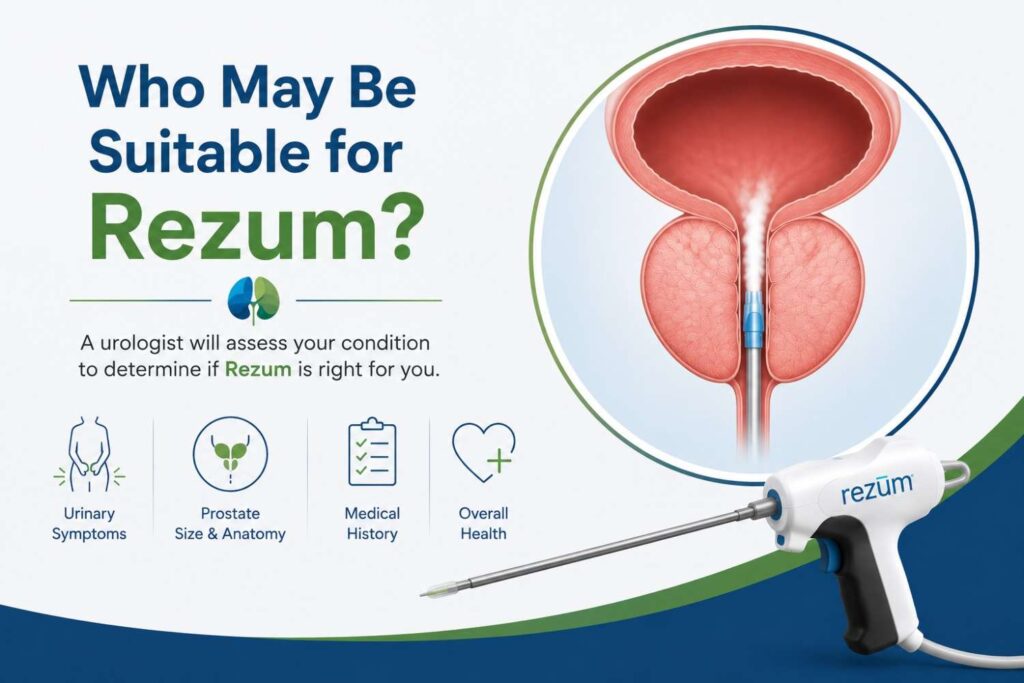
Rezum is not automatically appropriate for every man with BPH.A urologist needs to assess the individual patient before recommending treatment.Factors that may be considered include:
- Severity of urinary symptoms
- Prostate size
- Prostate anatomy
- Previous BPH treatment
- Response to medication
- Overall health
- Bladder function
- Patient expectations
- Individual treatment goals
Men Considering Minimally Invasive BPH Treatment
Rezum may be discussed with men who have bothersome urinary symptoms and are looking for an alternative to certain medication or surgical approaches.However, suitability should always be determined through professional medical evaluation.
Benefits of Rezum Therapy
Understanding HOW DOES REZUM THERAPY WORK? also helps explain why some patients consider it.
- Minimally Invasive Approach
Rezum is performed through the urinary passage rather than through an external surgical incision.
- Targeted Treatment
Water vapor can be delivered to selected areas of prostate tissue.
- No External Surgical Incision
The treatment does not require an abdominal incision.
- Gradual Tissue Reduction
The body naturally processes the treated prostate tissue over time.
- Short Procedure
The treatment itself is generally relatively brief, although the total healthcare visit depends on preparation, anesthesia, monitoring, and individual circumstances.
- Sexual Function Considerations
Rezum has been developed with preservation of sexual function as an important consideration. However, individual results can vary, and patients should discuss potential effects with their urologist.
- Alternative to Some Surgical Approaches
For appropriately selected patients, Rezum can be considered alongside other BPH treatment options.
What to Expect After Treatment
The healing period is an important part of understanding HOW DOES REZUM THERAPY WORK?Because the treatment depends on the body’s response to the treated tissue, symptoms may temporarily change before they improve.
Some patients may experience:
- Increased urinary frequency
- Urinary urgency
- Burning during urination
- Blood in the urine
- Blood in semen
- Pelvic discomfort
- Temporary changes in urinary flow
These symptoms can occur during the healing period.The treating doctor may prescribe medications or provide other instructions to manage the recovery process.
Why Is a Urology Consultation Important?
Although online information can explain HOW DOES REZUM THERAPY WORK?, it cannot determine whether Rezum is suitable for a particular patient.BPH symptoms can have different causes, and urinary symptoms should be properly evaluated.A urologist may assess the prostate, bladder, urinary flow, medical history, and other relevant factors before recommending treatment.A consultation also provides an opportunity to compare Rezum with medication, TURP, laser procedures, UroLift, and other appropriate options.
Conclusion
Understanding HOW DOES REZUM THERAPY WORK? starts with its use of controlled water-vapor energy. The treatment targets selected areas of enlarged prostate tissue, creating a controlled thermal response. The body then gradually processes the treated tissue, which can help reduce obstruction and improve urinary symptoms over time.Unlike procedures that physically remove prostate tissue, Rezum relies on a gradual healing process. This means patients need realistic expectations about recovery and should understand that improvement may develop over several weeks and months.For anyone researching HOW DOES REZUM THERAPY WORK?, the most important next step is a consultation with a qualified urologist. A professional assessment can determine whether Rezum is appropriate and help compare it with other BPH treatment options. For more detailed medical information about Benign Prostatic Hyperplasia, visit the Urology Care Foundation’s guide to BPH.