
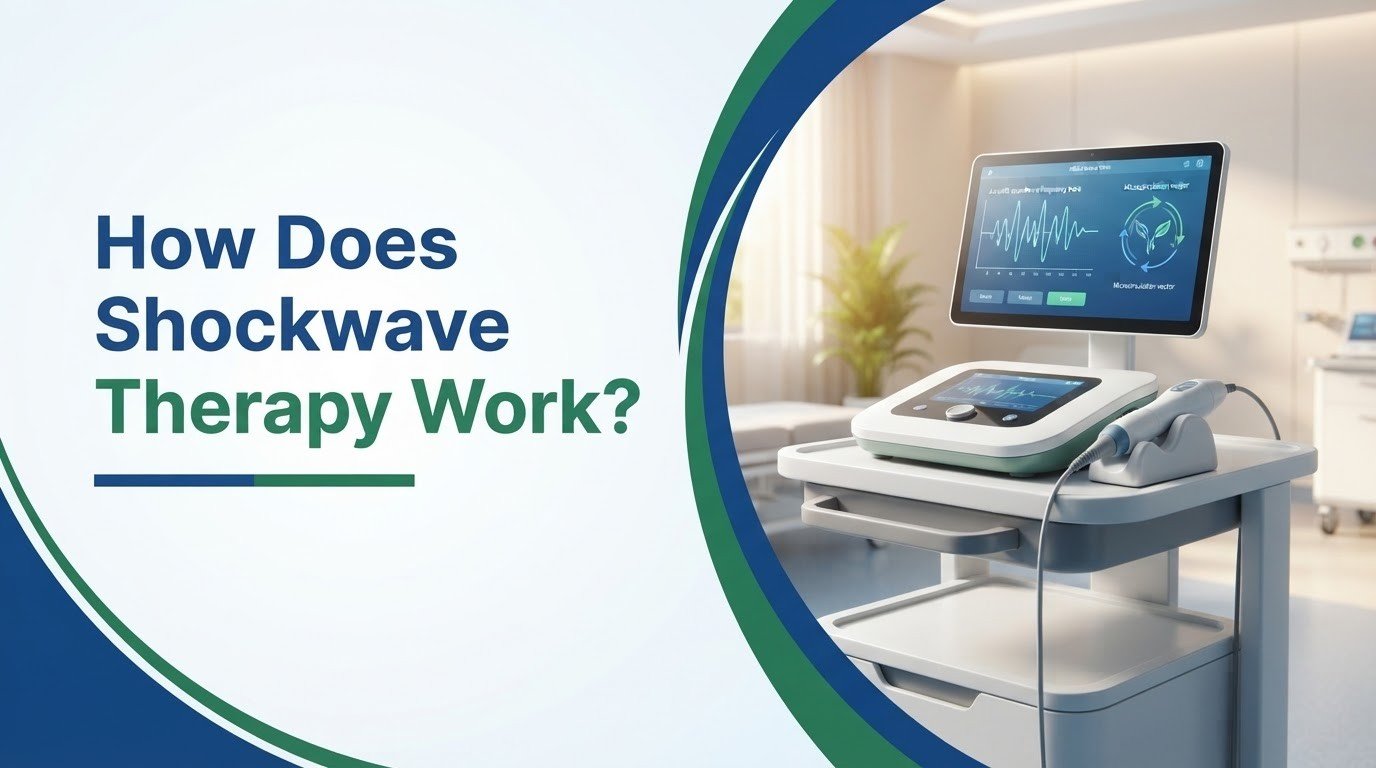
How Does Shockwave Therapy Work? Shockwave therapy is a medical technique that uses controlled sound waves, known as acoustic waves, to stimulate tissues in a selected area of the body. Depending on the type of treatment, it may be used for certain tendon problems or studied as a treatment for erectile dysfunction in men.
To understand the basic idea, imagine that the body is made up of tiny cells, blood vessels and tissues that work together. When a tissue is injured or its normal function is affected, researchers investigate whether controlled acoustic waves can encourage biological responses that may support recovery or improve function.
However, not all shockwave treatments work in the same way. Low-intensity shockwave therapy for erectile dysfunction is different from shockwave therapy used for tendon problems or high-energy shockwave lithotripsy used to break certain kidney stones.
For people exploring urological care in Thrissur, understanding the science behind shockwave therapy can help them ask better questions during a medical consultation. The treatment’s suitability depends on the condition being addressed, the available evidence and the patient’s overall health.
Table of Contents
How Does Shockwave Therapy Work?
What Are the Different Types of Shockwave Therapy?
How Does Shockwave Therapy Work for Erectile Dysfunction?
What Happens During a Shockwave Therapy Session?
What Are the Potential Benefits?
What Are the Risks and Limitations?
Who May Be Suitable for Shockwave Therapy?
How Does Shockwave Therapy Compare With Other Treatments?
How Can You Prepare for a Medical Consultation?
Frequently Asked Questions
1. How Does Shockwave Therapy Work?
Shockwave therapy works by delivering controlled acoustic energy to a targeted area of the body. A specialised device generates waves that travel through a treatment applicator and interact with the tissues.
The way these waves affect the body depends on their energy, the device used, the treatment area and the medical condition being treated.
In simple terms, the treatment aims to stimulate a response in the targeted tissue. Researchers have investigated whether these responses can influence circulation, tissue repair or other biological processes.
The process can be understood through four basic steps.
Step 1: The device produces acoustic waves.
A specialised medical device generates controlled sound waves. The settings are selected according to the intended treatment and the clinician’s protocol.
Step 2: The waves reach the targeted tissue.
The clinician places the treatment applicator against the skin or uses the appropriate method for the particular procedure. The acoustic energy is directed towards the intended area.
Step 3: The waves interact with the tissue.
The energy may stimulate biological responses within the targeted tissues. The precise response depends on the type of shockwave treatment and the condition being addressed.
Step 4: The clinician evaluates the results.
The patient’s symptoms and response are assessed over time. The treatment may be helpful for some conditions, but the benefits are not guaranteed and vary according to the medical application.
A useful point to remember is that shockwave therapy does not simply repair every type of tissue problem. The biological mechanisms and clinical benefits differ between conditions, and evidence supporting one use cannot automatically be applied to another.
For example, low-intensity shockwave therapy for erectile dysfunction is intended to influence tissue responses associated with blood flow. Shockwave lithotripsy, by contrast, uses focused energy to break certain kidney stones into smaller pieces.
2. What Are the Different Types of Shockwave Therapy?
The term shockwave therapy refers to several procedures that use acoustic energy for different medical purposes. Understanding these differences helps patients avoid confusion.
Low-intensity shockwave therapy
Low-intensity extracorporeal shockwave therapy, often shortened to LI-ESWT, has been studied for erectile dysfunction. It uses low-energy acoustic waves delivered externally to selected tissues.
Researchers are investigating whether the treatment can improve erectile function in some men by influencing blood vessel function and other tissue responses. The evidence suggests possible benefits, but the certainty of the research remains limited.
Shockwave therapy for tendon and soft-tissue conditions
Other extracorporeal shockwave treatments are used for selected musculoskeletal conditions. Depending on the condition, they may aim to reduce pain or stimulate a local tissue response.
The equipment and treatment settings can differ from those used in low-intensity therapy for erectile dysfunction.
Shockwave lithotripsy for kidney stones
Extracorporeal shockwave lithotripsy is a urological procedure used to break certain kidney stones into smaller fragments. These fragments may then pass through the urinary system.
Not every kidney stone is suitable for this treatment. Factors such as stone size, location and the patient’s medical condition help determine the appropriate option.
Why the differences matter
Patients should ask which type of shockwave therapy is being proposed and what condition it is intended to treat. A device used for one purpose should not automatically be assumed to be suitable for another.
3. How Does Shockwave Therapy Work for Erectile Dysfunction?
Erectile dysfunction (ED) occurs when a man has difficulty achieving or maintaining an erection firm enough for sexual activity. It can be associated with problems involving blood vessels, nerves, hormones, medicines, emotional wellbeing or general health.
An erection depends partly on blood flowing into erectile tissues. When blood vessel function is impaired, achieving or maintaining an erection may become difficult.
Low-intensity shockwave therapy for erectile dysfunction aims to stimulate tissue responses that may support blood vessel function and circulation.
Researchers have investigated several possible biological mechanisms.
Blood vessel responses: Acoustic waves may influence biological pathways involved in the function of small blood vessels.
Possible formation of new blood vessels: The development of new blood vessels is called neovascularisation. Researchers are studying whether shockwave therapy can encourage processes associated with this response.
Potential changes in erectile function: If blood flow improves sufficiently, some men may experience better erections. However, this outcome is not guaranteed, and the treatment may not address erectile dysfunction caused by other factors.
It is important to distinguish between a proposed mechanism and a proven clinical result. Even when a treatment stimulates a biological response, the improvement may be small or may not be noticeable to the patient.
A Cochrane review published in 2025 examined 21 studies involving 1,357 men. It found that low-intensity shockwave therapy may improve erectile function to some extent, but confidence in the evidence was low because of study limitations and differences in treatment methods. The review also found insufficient information about patient satisfaction and sexual quality of life.
For this reason, shockwave therapy should not be described as a guaranteed cure for erectile dysfunction.
4. What Happens During a Shockwave Therapy Session?
The treatment process depends on the medical condition, the device and the clinician’s protocol. When low-intensity shockwave therapy is being considered for erectile dysfunction, the process generally involves a consultation, assessment, treatment and follow-up.
Medical consultation: The clinician reviews symptoms, medical history, current medicines and previous treatments. For erectile dysfunction, the assessment may include questions about diabetes, blood pressure, smoking and other factors affecting circulation.
Treatment planning: The clinician determines whether the proposed treatment is appropriate and explains the potential benefits, limitations, alternatives and costs. Patients should have the opportunity to ask questions before agreeing.
Preparation: If the treatment is considered suitable, the patient is positioned comfortably. The clinician prepares the treatment area according to the device instructions.
Delivery of acoustic waves: The device delivers controlled pulses to the targeted tissue. The procedure is generally performed externally and does not ordinarily require a surgical incision. Some patients may experience tapping sensations or mild discomfort.
Follow-up: The clinician reviews the patient’s response and discusses whether further treatment or another approach is appropriate.
The duration and number of sessions vary according to the treatment protocol. There is no single schedule that can be assumed to suit every patient.
Patients should be cautious about claims that a fixed number of sessions will guarantee permanent improvement. A responsible treatment plan should include an appropriate diagnosis and realistic expectations.
5. What Are the Potential Benefits of Shockwave Therapy?
The possible benefits depend on the condition being treated. Shockwave therapy may be helpful in certain medical situations, but the evidence differs between applications.
A non-surgical treatment approach
Many extracorporeal shockwave procedures are delivered externally without a surgical incision. This may be an advantage for patients who are suitable for such treatment and wish to avoid an invasive procedure.
Possible improvement in erectile function
Some studies suggest that low-intensity shockwave therapy may improve erectile function in selected men. However, the benefit may be modest, and some patients may not notice a meaningful change.
Short-term tolerability
Studies of low-intensity shockwave therapy for erectile dysfunction generally report few significant short-term treatment-related problems. However, this does not establish that every device or protocol has the same safety profile.
A chance to investigate underlying health concerns
Seeking medical advice for erectile dysfunction can help identify diabetes, high blood pressure, cardiovascular risk factors or medication-related effects. Addressing these concerns is important even when another treatment is being considered.
A treatment option to discuss with a specialist
A clinician can explain whether shockwave therapy has a role in the patient’s treatment plan or whether another approach is more appropriate.
What should patients realistically expect? The evidence does not establish that low-intensity shockwave therapy will work for everyone. The Cochrane review found possible improvements in erectile function, but the certainty of the evidence was low. These findings support informed discussion rather than promises of guaranteed results.
6. What Are the Risks and Limitations of Shockwave Therapy?
Understanding the limitations is an important part of choosing any medical treatment. Although low-intensity shockwave therapy has generally been well tolerated in clinical studies, no procedure should be described as completely risk-free.
Possible concerns include:
Temporary discomfort during a session.
Mild tenderness or irritation in the treated area.
Little or no improvement in symptoms.
The time required to attend multiple sessions.
Treatment and follow-up costs.
Uncertainty about how long any improvement may last.
The available research suggests that significant short-term side effects are uncommon in studies of low-intensity shockwave therapy for erectile dysfunction. However, the quality of evidence varies, and long-term outcomes remain uncertain.
Another limitation is that erectile dysfunction has many possible causes. If the problem is mainly related to nerve damage, hormonal changes, medication effects or psychological factors, a treatment aimed at blood vessel function may not address the underlying issue.
Before proceeding, patients should ask:
What is causing my symptoms?
Is this treatment suitable for my condition?
What level of improvement is realistic?
What other treatment options are available?
What is the total cost?
How will the results be evaluated?
What happens if the treatment does not help?
Be cautious about advertisements promising a permanent cure, immediate success or guaranteed results for every patient.
7. Who May Be Suitable for Shockwave Therapy?
Suitability depends on the medical condition, the cause of the symptoms, the patient’s health and the evidence supporting the procedure.
For erectile dysfunction, low-intensity shockwave therapy is most often discussed for selected men with mild, blood vessel-related ED. A urologist may review the patient’s symptoms, general health, medicines and response to previous treatments before discussing whether it is appropriate.
A medical assessment may be helpful for men who:
Have persistent difficulty achieving or maintaining an erection.
Have diabetes, high blood pressure or other conditions that may affect blood vessels.
Have tried other treatments without satisfactory results.
Want to understand non-surgical treatment approaches.
Need guidance about the benefits, risks and alternatives.
The therapy is not automatically suitable for every man with erectile dysfunction. Age alone does not determine suitability, and the cause of the problem is more important than age by itself.
A clinician may recommend a physical examination, blood tests or additional investigations. Depending on the symptoms, these may include tests for diabetes, cholesterol problems or hormonal conditions.
The European Association of Urology allows consideration of low-intensity shockwave therapy in selected patients, including some men with mild vasculogenic ED. This is a weak recommendation, reflecting the limitations of the available evidence.
8. How Does Shockwave Therapy Compare With Other Treatments?
Shockwave therapy is one of several treatment approaches that may be discussed for erectile dysfunction. The most appropriate option depends on the cause, general health, previous treatment and personal preferences.
Treatment | How it works | Important consideration |
|---|---|---|
Lifestyle changes | Support circulation and overall health | May help but may not be sufficient alone |
Oral medicines | Improve the blood-flow response involved in erections | Established option when medically appropriate |
Low-intensity shockwave therapy | Uses acoustic waves to stimulate tissue responses | Benefits remain uncertain |
Vacuum erection devices | Use suction to help draw blood into the penis | Require correct use |
Local medicines or injections | Help produce an erection through a drug effect | Require medical guidance |
Penile implant surgery | Uses an implanted device to help produce an erection | An invasive option for selected patients |
Oral medicines known as phosphodiesterase type 5 inhibitors are established treatments for many men with erectile dysfunction. However, they are not suitable for everyone. Some must not be combined with nitrate medicines used for certain heart conditions because the combination can cause a dangerous fall in blood pressure.
Shockwave therapy differs because it aims to stimulate tissue responses rather than directly support the erection process around the time of sexual activity. Whether it provides a meaningful and lasting advantage remains uncertain.
Patients should not stop prescribed medicines or begin unregulated sexual-health products without medical advice. A qualified clinician can explain the available options and whether additional investigations are needed.
9. How Can You Prepare for a Urology Consultation?
Preparing for a medical appointment can help patients understand their symptoms and treatment options more clearly.
Before the appointment:
Write down when the symptoms started and how often they occur.
Prepare a list of prescription medicines, over-the-counter medicines and supplements.
Mention existing conditions such as diabetes, high blood pressure or heart disease.
Bring details of previous tests or treatments, if available.
Ask whether the proposed procedure is established or still under investigation.
Request information about alternatives, costs and follow-up care.
For erectile dysfunction, a clinician may review the medical history, perform a physical examination and recommend selected blood tests. These may help identify diabetes, cholesterol problems or hormonal conditions.
Patients should feel comfortable asking sensitive questions. Erectile dysfunction is a medical concern, and discussing it with a qualified professional is a reasonable step towards understanding its cause.
For people seeking urological care in Thrissur, JR Nathan Urology lists urological treatments including Rezum therapy, laser stone removal, TURP, RIRS and UroLift. Low-intensity shockwave therapy for erectile dysfunction is not specifically listed among the treatments on its published homepage, so contact the centre directly to confirm whether this particular procedure is available.