Recovery After Rezum Treatment: What to Expect
Understanding recovery after Rezum treatment: what to expect can help men prepare for the days and weeks following minimally invasive treatment for benign prostatic hyperplasia (BPH). Rezum uses controlled water-vapor energy to treat selected prostate tissue. After the procedure, the body gradually processes the treated tissue, so improvement usually develops over time rather than immediately.For men considering treatment in Sharjah, knowing recovery after Rezum treatment: what to expect is just as important as understanding the procedure itself. Temporary urinary changes, medication instructions, catheter use when required, activity guidance, and follow-up can all form part of the recovery process.
Recovery After Rezum Treatment: What to Expect Immediately After the Procedure
- The first stage of recovery after Rezum treatment: what to expect begins immediately after the procedure.
- Once treatment is completed, the medical team observes the patient according to the clinical setting and individual circumstances.
- The actual treatment may be relatively brief, but patients should remember that their total time at the healthcare facility can include preparation, anesthesia, treatment, recovery, and observation.
- Some men may have a urinary catheter temporarily after the procedure. Whether a catheter is required depends on individual circumstances and the treating urologist’s assessment.
Before leaving, patients should understand:
- How to take prescribed medicines
- Whether a catheter is required
- How to manage the catheter if applicable
- What activities to avoid
- When normal activities can be resumed
- When follow-up is required
- Which symptoms should be reported
Clear instructions can make the early recovery period easier to manage.
Why Does Recovery Take Time?
One of the most important points about recovery after Rezum treatment: what to expect is that Rezum works gradually.The treatment does not simply remove obstructing prostate tissue during the procedure. Instead, water-vapor energy treats selected areas of the prostate. The body then gradually processes the treated tissue.As healing progresses, the treated tissue reduces and the urinary passage may have more room for urine flow.Because this biological process takes time, patients should not judge the final treatment outcome immediately after the procedure.
Common Symptoms During Recovery
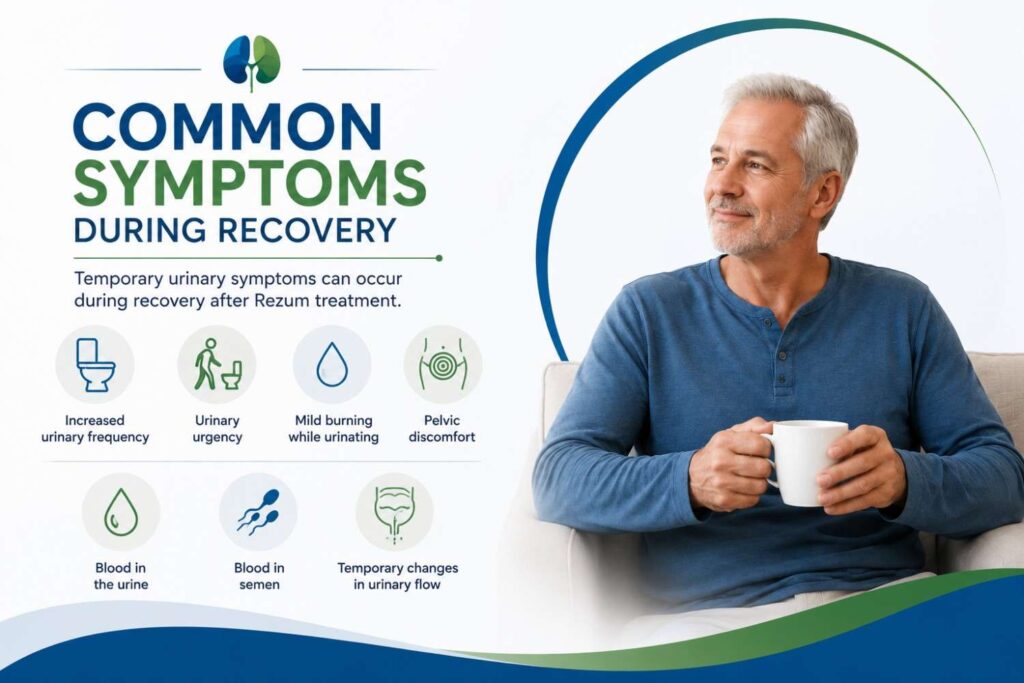
Temporary urinary symptoms can occur during recovery after Rezum treatment: what to expect.
The prostate and urinary tract may need time to settle after the treatment. Some patients may experience:
- Increased urinary frequency
- Urinary urgency
- Mild burning while urinating
- Pelvic discomfort
- Blood in the urine
- Blood in semen
- Temporary changes in urinary flow
These symptoms can vary from person to person.The supplied pillar content also identifies urinary frequency, urgency, mild burning, blood in urine or semen, pelvic discomfort, and changes in urinary flow as possible temporary recovery symptoms.Patients should follow their urologist’s specific instructions rather than assuming that every symptom has the same significance.
Recovery After Rezum Treatment: What to Expect During the First Few Days
The first several days are an important part of recovery after Rezum treatment: what to expect.Some patients may notice urinary symptoms more clearly during this period. This does not necessarily indicate that the treatment has not worked. The prostate is undergoing a healing response, and the final benefit develops gradually.
- Urinary Frequency
You may feel the need to urinate more often than usual.
- Urinary Urgency
A sudden need to urinate can occur temporarily while the urinary system recovers.
- Mild Burning
Some men may notice mild discomfort or burning during urination.
- Changes in Urinary Flow
The urinary stream may not immediately become stronger. In some cases, temporary changes in flow can occur during healing.
- Minor Blood in Urine
Blood in the urine can occur after treatment. Patients should follow the instructions provided by their urologist regarding what is expected and when to seek medical advice.
What About Catheter Recovery?
Catheter use can be part of recovery after Rezum treatment: what to expect for some patients.A catheter is a thin tube used to help drain urine from the bladder. Whether one is needed after Rezum depends on factors such as the patient’s urinary function, prostate characteristics, and the doctor’s assessment.
If a catheter is used, the healthcare team should explain:
- How to keep the catheter clean
- How to manage the drainage bag
- How to recognize possible problems
- When the catheter is expected to be removed
- When to contact the medical team
Patients should never remove or manipulate a catheter unless specifically instructed to do so by their healthcare provider.
How Long Does Rezum Recovery Take?
A common question about recovery after Rezum treatment: what to expect is how long the entire process will take.There is no single recovery timeline that applies to every patient.Some men may begin noticing urinary changes within several weeks, while further improvement may continue over the following months.
The recovery process can be influenced by:
- Prostate size
- Prostate anatomy
- Severity of symptoms before treatment
- Number of treatment applications
- Individual healing response
- Overall health
- Previous BPH treatments
The supplied pillar content similarly notes that improvement can begin within several weeks for some patients, with continued improvement over the following months.The most useful approach is to follow your urologist’s recovery plan rather than comparing your progress with someone else’s.
Recovery After Rezum Treatment: What to Expect in the Following Weeks
The weeks following treatment are a gradual transition from initial healing toward symptom improvement.During this stage, urinary symptoms may fluctuate. Some patients may experience periods where frequency or urgency remains noticeable before gradually improving.It is important to remember that the prostate is still undergoing changes.
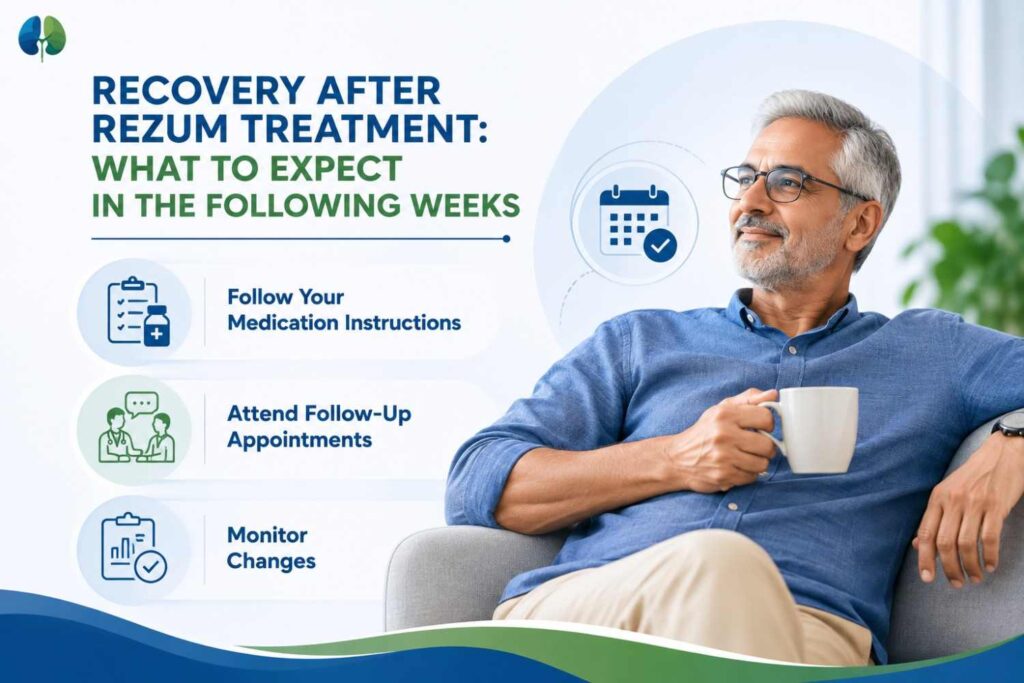
Follow Your Medication Instructions
Your doctor may prescribe medicines to support recovery or manage temporary symptoms. Take them exactly as directed.Do not stop, restart, or change prescription medicines without discussing this with your healthcare provider.
Attend Follow-Up Appointments
Follow-up visits allow the urologist to evaluate:
- Urinary symptoms
- Bladder emptying
- Recovery progress
- Catheter status when applicable
- Possible complications
- Overall response to treatment
Monitor Changes
Keeping track of urinary symptoms can help you explain your recovery accurately during follow-up.
When Can You Return to Normal Activities?
Activity recommendations are an important part of recovery after Rezum treatment: what to expect.The timing for returning to work, exercise, driving, sexual activity, and other routines can differ according to the patient’s health, treatment setting, and doctor’s instructions.
Instead of following a generic timeline, ask your urologist specifically about:
- Returning to work
- Driving
- Exercise
- Heavy lifting
- Sexual activity
- Travel
- Bathing and other personal-care activities
Your individual instructions should take priority.
What Should You Avoid During Recovery?
Knowing recovery after Rezum treatment: what to expect also includes understanding what may need to be limited temporarily.Your urologist may recommend restrictions depending on your individual situation.
Potential areas to discuss include:
- Strenuous exercise
- Heavy lifting
- Certain sexual activities
- Long periods of physical exertion
- Travel immediately after treatment
- Activities that may interfere with catheter care
There is no universal recovery schedule for every patient. Follow the specific instructions provided after your procedure.
When Should You Contact Your Doctor?
Understanding warning signs is an important part of recovery after Rezum treatment: what to expect.Patients should follow the specific emergency and follow-up instructions given by their healthcare provider.Contact your medical team if you experience symptoms that are severe, rapidly worsening, or different from what you were told to expect.
Particular concerns may include:
- Difficulty passing urine
- Significant or worsening bleeding
- Severe or increasing pain
- Fever or chills
- Possible signs of infection
- Problems with a catheter
- Symptoms that concern you or do not match your post-treatment instructions
If you are unsure whether a symptom is expected, it is safer to ask the treating medical team.
Conclusion
Understanding recovery after Rezum treatment: what to expect can help patients prepare for the healing period with realistic expectations. Rezum is designed as a minimally invasive BPH treatment using controlled water-vapor energy, but the benefits develop gradually as the body processes the treated prostate tissue.Temporary urinary frequency, urgency, mild burning, pelvic discomfort, blood in urine or semen, and changes in urinary flow may occur during recovery. These symptoms can vary between patients, which is why following personalized medical instructions is essential.The most important part of recovery after Rezum treatment: what to expect is patience and appropriate follow-up. Taking prescribed medicines, following activity guidance, attending appointments, and communicating unexpected symptoms with your urologist can help support a well-monitored recovery. Men considering BPH treatment in Sharjah should discuss their individual recovery expectations, possible risks, and treatment alternatives with a qualified urologist.For more detailed medical information about Benign Prostatic Hyperplasia, visit the Urology Care Foundation’s guide to BPH.