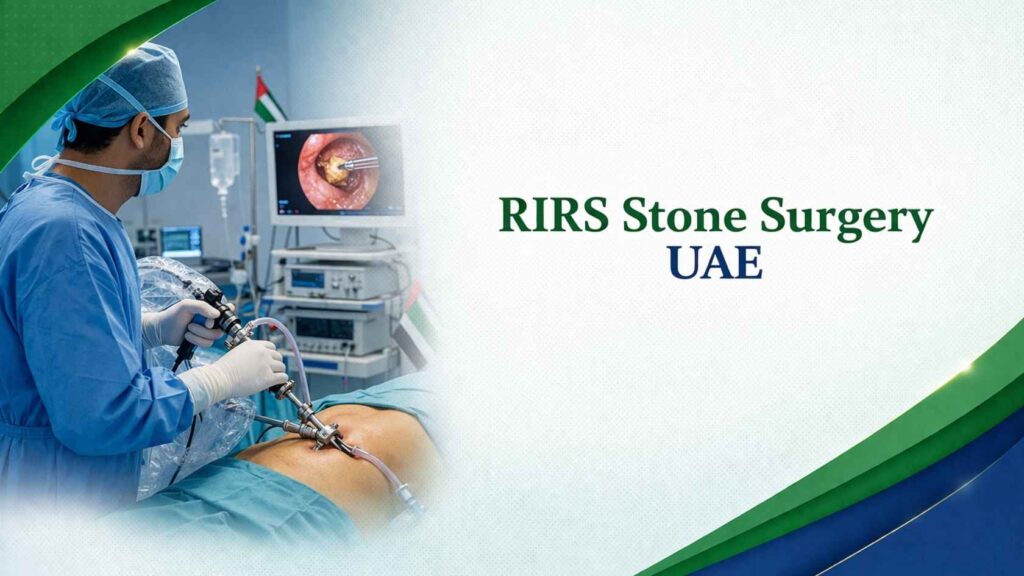
RIRS Stone Surgery UAE
Retrograde Intrarenal Surgery (RIRS) is an advanced, minimally invasive procedure used to treat kidney stones without making any external cuts. Patients seeking modern, effective stone removal options in the UAE often choose RIRS because it offers high success rates, faster recovery, and minimal discomfort compared to traditional open or percutaneous surgeries. This technique uses a flexible scope inserted through the natural urinary passage to access the kidney and break stones into tiny fragments that can pass naturally.
What Is RIRS Stone Surgery?
RIRS (Retrograde Intrarenal Surgery) is a specialized endoscopic procedure designed to treat stones located inside the kidney. Unlike conventional surgery, RIRS does not involve incisions on the skin. Instead, a thin, flexible instrument called a ureteroscope is passed through the urethra, bladder, and ureter directly into the kidney.
Once the surgeon reaches the stone, a laser fiber is used to fragment it into very small pieces. These fragments either pass out naturally through urine or are removed using tiny baskets.
Who Needs RIRS Stone Surgery?
RIRS is typically recommended for patients who have:
- Kidney stones smaller than 2 cm
- Stones located in difficult-to-reach areas of the kidney
- Stones that failed previous treatments like shock wave therapy
- Multiple small stones
- Bleeding disorders (where other surgeries may be risky)
- Obesity, making external procedures difficult
- Anatomical abnormalities of the urinary tract
It is also suitable for patients who want a minimally invasive solution with quicker return to normal activities.
Types of Kidney Stones Treated with RIRS
RIRS can effectively treat most common kidney stone types, including:
- Calcium oxalate stones
- Calcium phosphate stones
- Uric acid stones
- Struvite stones
- Cystine stones (in selected cases)
The laser used in RIRS is powerful enough to break even hard stones into dust-like particles.
Pre-Surgery Evaluation
Before undergoing RIRS, patients typically undergo a thorough evaluation to ensure safety and effectiveness.
Common preoperative tests include:
- Ultrasound scan
- CT scan of kidneys, ureters, and bladder
- Urine analysis and culture
- Blood tests
- Kidney function tests
- ECG and medical clearance
If a urinary infection is present, it must be treated before surgery.
How RIRS Stone Surgery Is Performed
RIRS is done under general or spinal anesthesia, ensuring the patient feels no pain during the procedure.
Step-by-step process:
- The ureteroscope is inserted through the urethra into the bladder.
- It is gently advanced through the ureter to reach the kidney.
- A flexible scope allows navigation inside the kidney’s collecting system.
- A laser fiber targets the stone.
- The stone is broken into tiny fragments.
- Fragments are removed or left to pass naturally.
- A temporary stent may be placed to ensure smooth urine flow.
The entire procedure usually takes 60 to 120 minutes, depending on stone size and number.
What Is a Ureteral Stent and Why Is It Used?
After RIRS, a soft tube called a double-J (DJ) stent may be placed inside the ureter. This stent:
- Prevents blockage from swelling or stone fragments
- Allows urine to drain freely
- Reduces pain and complications
- Promotes healing
The stent is temporary and usually removed after 1–3 weeks through a simple outpatient procedure.
Advantages of RIRS Over Traditional Surgery
RIRS has become increasingly popular due to its many benefits:
Minimally invasive: No cuts or stitches
Less pain: Reduced postoperative discomfort
Short hospital stay: Often discharged within 24 hours
Quick recovery: Resume normal activities sooner
Minimal bleeding: Very low blood loss
Safe for high-risk patients: Including elderly or obese individuals
High precision: Flexible scope reaches complex kidney areas.
Success Rate of RIRS
RIRS offers a high stone-free rate, especially for stones under 2 cm.
Factors affecting success include:
- Stone size
- Stone hardness
- Stone location
- Surgeon experience
- Patient anatomy
- Presence of multiple stones
In some cases, a second session may be required for complete clearance.
Recovery After RIRS Surgery
Recovery is generally smooth and quick compared to other surgical options.
Immediately after surgery:
- Mild burning during urination
- Slight blood in urine for a few days
- Increased urinary frequency
- Mild flank discomfort
Within a few days:
- Pain decreases significantly
- Normal diet can be resumed
- Light activities allowed
Within 1–2 weeks:
- Most patients return to routine work
- Stent removal if placed
Post-Operative Care Tips
Proper care after surgery helps prevent complications and ensures faster healing.
Recommended precautions:
- Drink plenty of water
- Avoid heavy lifting for a short period
- Take prescribed medications regularly
- Complete the antibiotic course if given
- Watch for signs of infection
- Attend follow-up appointments
Possible Risks and Complications
Although RIRS is considered very safe, like any medical procedure, it carries some risks.
Potential complications include:
- Urinary tract infection
- Fever
- Temporary blood in urine
- Pain due to stent
- Ureteral injury (rare)
- Incomplete stone removal
- Need for repeat procedure
Serious complications are uncommon when performed by experienced specialists.
RIRS vs Other Kidney Stone Treatments
RIRS vs Shock Wave Therapy (ESWL)
- RIRS: Direct visualization and laser fragmentation
- ESWL: External shock waves; less effective for hard stones
RIRS vs PCNL (Percutaneous Surgery)
- RIRS: No incision
- PCNL: Small back incision required
- RIRS: Better for small to medium stones
- PCNL: Preferred for very large stones
RIRS vs Open Surgery
- RIRS: Minimally invasive
- Open surgery: Rarely needed today
Who Should Avoid RIRS?
RIRS may not be suitable for:
- Extremely large kidney stones
- Severe ureteral narrowing
- Active untreated infections
- Certain anatomical abnormalities
- Patients unfit for anesthesia
A thorough medical evaluation determines the best treatment option.
Long-Term Prevention After Stone Removal
Removing the stone does not eliminate the risk of recurrence. Preventive measures are essential.
Lifestyle recommendations:
- Drink 2.5–3 liters of water daily
- Reduce salt intake
- Limit oxalate-rich foods if advised
- Maintain healthy body weight
- Avoid excessive animal protein
- Follow dietary advice based on stone type
Periodic checkups help detect new stones early.
Signs That Require Immediate Medical Attention
After RIRS, contact a healthcare provider urgently if you experience:
- High fever or chills
- Severe pain not relieved by medication
- Persistent vomiting
- Heavy bleeding in urine
- Difficulty passing urine
- Signs of infection
Prompt treatment prevents complications.
Why RIRS Is Considered a Modern Gold Standard
Technological advances have made RIRS one of the most preferred treatments for kidney stones worldwide. Its combination of safety, precision, and quick recovery makes it especially suitable for patients seeking effective stone removal without major surgery.
Flexible scopes, high-power lasers, and improved imaging allow surgeons to treat stones that were previously difficult to access. As a result, patients benefit from shorter hospital stays, minimal discomfort, and excellent outcomes.
Conclusion
RIRS stone surgery is a highly advanced, minimally invasive solution for kidney stone removal that offers excellent success rates with minimal pain and downtime. Patients across the UAE increasingly prefer this technique because it eliminates the need for cuts while delivering precise and effective stone clearance. With proper evaluation, expert surgical care, and post-treatment prevention strategies, RIRS provides a safe pathway to long-term relief from kidney stones in the UAE.
Frequently Asked Questions
1. What is RIRS stone surgery?
RIRS (Retrograde Intrarenal Surgery) is a minimally invasive procedure used to remove kidney stones using a flexible scope passed through the urinary tract without any external cuts.
2. Is RIRS surgery painful?
The procedure itself is not painful because it is performed under anesthesia. After surgery, patients may experience mild discomfort, burning during urination, or slight flank pain, which usually subsides within a few days.
3. How long does RIRS surgery take?
RIRS typically takes about 60 to 120 minutes, depending on the size, number, and location of the kidney stones.
4. What size stones can be treated with RIRS?
RIRS is most effective for kidney stones up to 2 cm in size. Larger stones may require multiple sessions or alternative procedures.
5. Is hospitalization required after RIRS?
Most patients stay in the hospital for less than 24 hours. Some may even be discharged on the same day, depending on recovery.
6. Will a stent be placed after RIRS surgery?
In many cases, a temporary ureteral stent is inserted to help urine flow and prevent blockage. It is usually removed after 1–3 weeks.
7. How long is the recovery period?
Most patients can return to normal daily activities within a few days and resume work within 1–2 weeks.
8. Are there any risks or complications?
RIRS is generally safe, but possible risks include infection, mild bleeding, fever, temporary pain, or incomplete stone removal.
9. Can kidney stones come back after RIRS?
Yes, stones can recur. Proper hydration, dietary changes, and regular follow-ups help reduce the risk of recurrence.
10. Is RIRS better than shock wave therapy?
RIRS is often more effective for hard stones, multiple stones, or stones in difficult locations, while shock wave therapy may be suitable for smaller, softer stones.