
9 Proven Ways to Find a Urologist for Rezum Therapy in Dubai
Choosing a qualified Urologist for Rezum Therapy in Dubai is an important decision for men experiencing urinary symptoms caused by benign prostatic hyperplasia, commonly known as BPH. Frequent urination, poor urine flow, urgency, interrupted sleep, and difficulty emptying the bladder can gradually affect daily comfort and confidence.
Rezum therapy is a minimally invasive procedure that uses controlled water-vapour energy to treat selected enlarged prostate tissue. Although the technology is important, the experience of the urologist, quality of patient assessment, treatment planning, and follow-up care also influence the overall treatment journey.
What Is Rezum Therapy?
Rezum therapy is a minimally invasive treatment designed to reduce urinary obstruction caused by an enlarged prostate.
During the procedure, a narrow medical instrument is passed through the urethra. Small amounts of sterile water vapour are delivered into specific areas of enlarged prostate tissue.
When the steam reaches the targeted tissue, its stored thermal energy affects the unwanted cells. The body gradually absorbs this treated tissue over the following weeks and months.
As the enlarged tissue reduces, pressure on the urethra may decrease. This can help improve urinary flow and bladder emptying.
Rezum therapy generally:
- Does not require an external surgical incision
- Uses controlled water-vapour energy
- Can often be completed as a day-care procedure
- Allows gradual reduction of enlarged tissue
- May offer a shorter recovery than major prostate surgery
- Can reduce dependence on long-term BPH medicines
- May preserve important urinary and sexual functions
A qualified Urologist for Rezum Therapy in Dubai should explain both the expected benefits and the limitations before recommending the procedure.
Understanding Benign Prostatic Hyperplasia
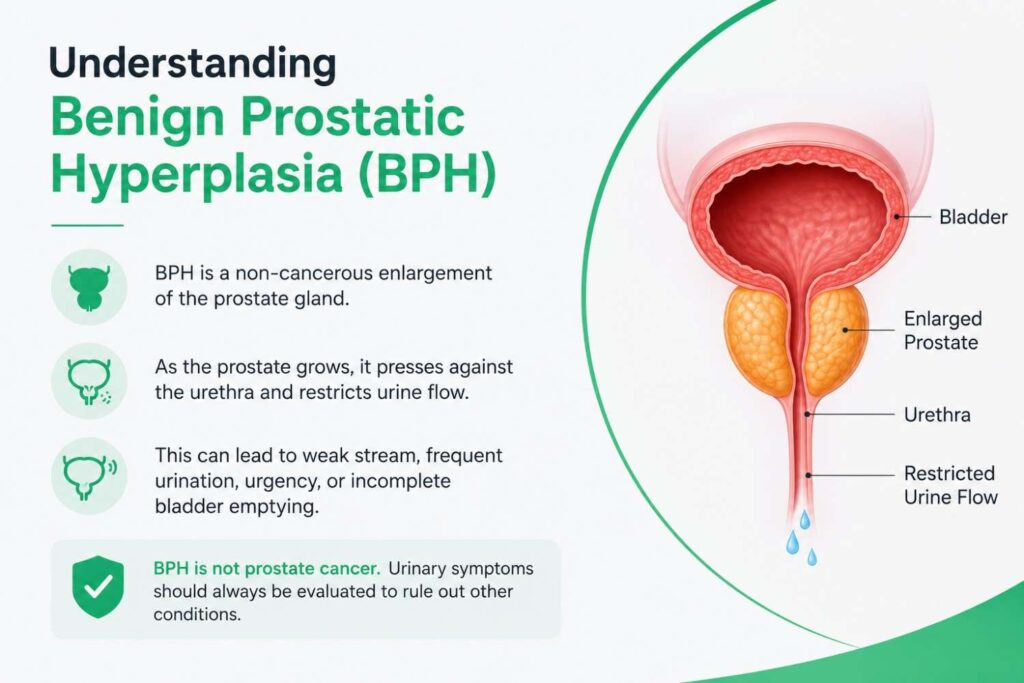
Benign prostatic hyperplasia is a non-cancerous enlargement of the prostate gland. The prostate is positioned below the bladder and surrounds part of the urethra.
As the prostate grows, it may press against the urethra and restrict the normal passage of urine. The bladder must then work harder to push urine through the narrowed area.
Over time, this increased effort can cause changes in bladder function. Some men develop urgency and frequent urination, while others experience a weak stream or incomplete emptying.
BPH is different from prostate cancer. However, urinary symptoms should always be properly evaluated because infections, bladder conditions, urethral narrowing, medication effects, and other prostate disorders may produce similar signs.
Common Symptoms of BPH
Symptoms of an enlarged prostate may develop gradually. Many men initially adapt their routines without realising how much the condition is affecting them.
Common symptoms include:
- Frequent urination
- Waking several times during the night to urinate
- Sudden urinary urgency
- Difficulty delaying urination
- Weak or slow urine stream
- Trouble beginning urination
- Straining to pass urine
- Interrupted urine flow
- Dribbling after urination
- Feeling that the bladder is not completely empty
- Needing to urinate again shortly after leaving the toilet
- Taking longer than usual to empty the bladder
Persistent symptoms should be assessed by a urologist rather than managed only by reducing water intake or changing daily routines.
Types of Urinary Symptoms
BPH-related urinary symptoms are commonly divided into three categories.
Storage Symptoms
These occur while the bladder is filling and storing urine.
They include:
- Urinary frequency
- Urgency
- Night-time urination
- Urge-related leakage
Voiding Symptoms
These happen while urine is passing out of the bladder.
They include:
- Weak stream
- Hesitancy
- Straining
- Interrupted flow
- Prolonged urination
Post-Voiding Symptoms
These occur immediately after urination.
They include:
- Post-urination dribbling
- Feeling of incomplete emptying
- Returning to the toilet within a short time
Understanding the type of symptoms helps the urologist determine whether obstruction from the prostate is the main problem or whether the bladder also requires treatment.
When Urinary Symptoms Need Urgent Care
Most BPH symptoms are not emergencies. However, certain warning signs require prompt medical attention.
Seek urgent care if you experience:
- Complete inability to pass urine
- Severe lower abdominal pressure or pain
- Fever with painful urination
- Chills or significant weakness
- Visible blood in the urine
- Repeated urinary infections
- Severe back or side pain
- Vomiting with urinary symptoms
- Sudden reduction in urine output
- Confusion associated with infection
Acute urinary retention may require immediate catheterisation. Treatment decisions about Rezum are usually made after the urgent problem has been stabilised.
How a Urologist Evaluates BPH
A careful assessment is necessary before choosing Rezum therapy. Urinary symptoms alone do not confirm that a patient is suitable.
Medical History
The urologist may ask about:
- When the symptoms began
- How often they occur
- Night-time urination
- Urgency and leakage
- Previous urinary infections
- Current medication
- Earlier prostate procedures
- Medical conditions
- Sexual function
- The effect of symptoms on daily life
Symptom Scoring
A structured questionnaire may be used to measure the severity of symptoms and their impact on quality of life.
Physical Examination
The specialist may examine the abdomen and, when clinically appropriate, assess the prostate.
Urine Analysis
A urine test can help identify infection, blood, glucose, or other abnormalities.
Blood Tests
Blood tests may be used to assess kidney function and prostate-related markers when medically appropriate.
Urine Flow Measurement
A uroflowmetry test measures how quickly urine passes and whether the flow pattern suggests obstruction.
Residual Urine Test
Ultrasound can measure the amount of urine remaining in the bladder after urination.
Prostate Imaging
Imaging can help evaluate prostate size, shape, and obstructing tissue.
Cystoscopy
A thin camera may be used in selected cases to examine the urethra, prostate channel, and bladder.
An experienced Urologist for Rezum Therapy in Dubai should use these findings to determine whether water-vapour treatment is appropriate.
Who May Be Suitable for Rezum Therapy?
Rezum may be considered for men who:
- Have moderate or bothersome BPH symptoms
- Have confirmed prostate-related urinary obstruction
- Have not obtained enough relief from medication
- Experience unwanted medication side effects
- Prefer a minimally invasive treatment
- Want to avoid major surgery when possible
- Have suitable prostate size and anatomy
- Can follow catheter-care guidance
- Can attend scheduled follow-up appointments
- Understand that improvement develops gradually
The treatment may also appeal to men concerned about certain side effects associated with conventional prostate surgery. However, no procedure can guarantee preservation of every function.
Who May Need an Alternative Treatment?
Some patients may require another treatment instead of Rezum.
Alternative care may be considered when there is:
- Active urinary infection
- Untreated bladder stones
- Severe urethral narrowing
- Significant bladder-muscle weakness
- Complex prostate anatomy
- Certain neurological bladder conditions
- Suspicion of another prostate disease
- Severe obstruction requiring rapid relief
- Previous surgery affecting urinary access
- A very large prostate requiring tissue removal
- Inability to safely undergo the planned procedure
A responsible urologist should explain why another option may be more suitable rather than recommending Rezum to every patient.
9 Proven Ways to Choose a Urologist for Rezum Therapy in Dubai
1. Check the Urologist’s Qualifications
Choose a doctor with recognised training in urology and experience managing benign prostate conditions.
The specialist should understand:
- BPH diagnosis
- Lower urinary tract symptoms
- Prostate anatomy
- Bladder function
- Minimally invasive treatments
- Catheter management
- Prostate surgery alternatives
Qualifications alone are not enough, but they provide an important foundation for safe care.
2. Ask About Rezum Experience
A trained Urologist for Rezum Therapy in Dubai should be familiar with patient selection, procedural planning, steam-delivery technique, and follow-up.
Useful questions include:
- How often do you perform Rezum therapy?
- Which prostate sizes do you normally treat?
- How do you manage an enlarged median lobe?
- How do you decide the number of treatments?
- What complications do you commonly manage?
- When do you recommend another procedure instead?
Clear and balanced answers can help patients feel more informed.
3. Look for Complete Diagnostic Assessment
Rezum should not be recommended based only on a short description of symptoms.
A proper evaluation may include urine tests, flow measurement, residual urine assessment, prostate imaging, symptom scoring, and cystoscopy when necessary.
Complete testing helps reduce the risk of treating the wrong cause.
4. Confirm That Alternatives Are Discussed
A reliable specialist should explain other reasonable BPH treatments.
These may include:
- Lifestyle management
- Alpha-blocker medication
- Prostate-shrinking medication
- Combination medication
- Prostate lift procedures
- Laser treatment
- TURP
- Other minimally invasive procedures
- Open or robotic surgery for selected cases
Patients should understand why Rezum is being recommended over other options.
5. Review the Catheter-Care Plan
Temporary catheter use is common after Rezum therapy for some patients.
Ask:
- Will I need a catheter?
- How long might it remain?
- Who will remove it?
- What should I do if it stops draining?
- Whom should I contact after working hours?
- What happens if I cannot urinate after removal?
Reliable catheter support is an important part of treatment.
6. Ask About Anaesthesia and Comfort
The specialist should explain whether local anaesthesia, sedation, or another technique will be used.
The decision may depend on:
- Patient comfort
- Anxiety
- Procedure complexity
- Medical history
- Hospital protocol
- Anaesthesia safety
Patients should disclose allergies, previous anaesthesia reactions, heart conditions, breathing problems, and all medications.
7. Assess Communication Quality
The right urologist should communicate clearly without rushing the consultation.
Good communication includes:
- Explaining the diagnosis
- Showing relevant test findings
- Discussing treatment choices
- Describing realistic results
- Explaining possible risks
- Providing written instructions
- Answering questions respectfully
Avoid relying on guaranteed-result claims or promises of completely risk-free treatment.
8. Check Follow-Up Arrangements
Recovery does not end when the patient leaves the procedure room.
Follow-up may include:
- Catheter removal
- Infection assessment
- Medication review
- Symptom scoring
- Urine-flow testing
- Residual urine measurement
- Monitoring gradual improvement
- Discussing persistent symptoms
Structured follow-up helps identify complications early and evaluate the treatment response.
9. Consider the Entire Treatment Facility
The doctor’s skill is important, but the quality of the treatment environment also matters.
Consider whether the facility provides:
- Appropriate diagnostic testing
- Sterile procedural rooms
- Anaesthesia support
- Trained nursing staff
- Catheter-care assistance
- Emergency support
- Clear discharge guidance
- Easy access to follow-up appointments
A coordinated healthcare team can make the treatment and recovery process more comfortable.

Conclusion
Selecting a qualified Urologist for Rezum Therapy in Dubai is essential for accurate diagnosis, appropriate patient selection, careful treatment, and reliable follow-up. Rezum therapy may provide a minimally invasive option for men experiencing urinary obstruction from benign prostatic hyperplasia, particularly when medicines are ineffective or cause unwanted effects.
The treatment can offer gradual urinary improvement, shorter recovery, and reduced dependence on daily medication for suitable patients. However, temporary urinary discomfort, catheter use, infection, incomplete improvement, and the possibility of future treatment should also be considered.
A detailed consultation helps patients understand their prostate size, bladder function, treatment choices, expected recovery, and individual risks. Choosing an experienced Urologist for Rezum Therapy in Dubai who provides transparent information can support safer decision-making and more confident BPH care. For reliable medical information about benign prostatic hyperplasia (BPH), visit the U.S. National Library of Medicine (MedlinePlus) to learn more about its symptoms, causes, diagnosis, and treatment options.